
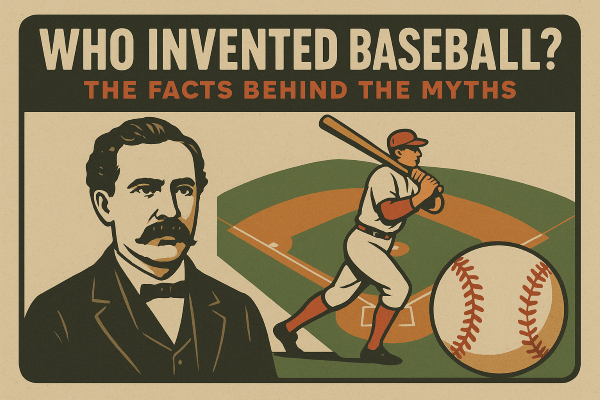
Early bat-and-ball games spread through communities, especially in New England and New York. Baseball’s roots trace to England (folk games brought by colonists), but modern baseball was codified in the United States. The key rule-making happened in New York City (Knickerbocker Club) in the 1840s. That’s why New York is often called the birthplace of modern baseball, even though similar games were played elsewhere.
A British book referenced “base-ball” as early as 1744. In America, informal baseball-type games existed in the early 1800s. The first formal rules were written in 1845, and the first recorded game under those rules took place on June 19, 1846.
Local clubs began writing down consistent rules. For example, in 1845 the New York Knickerbockers created the first ruleset (introducing the base paths, three-strike rule, etc.). Over the next decades, players and leagues kept refining the game. So baseball was “invented” by building on earlier games and gradually standardizing them.
A famous legend credits Abner Doubleday with inventing the game in 1839 in Cooperstown, New York. But that story doesn’t hold up. Doubleday was actually a West Point cadet in 1839 and never claimed to invent baseball. The Doubleday origin tale was concocted decades later (in 1907) by a special commission backed by baseball’s promoter A.J. Spalding. In reality, baseball’s true roots stretch much further back, with many people and communities adding pieces to the game over time.
Essentially, people created it for fun and competition. Communities loved playing bat-and-ball games, so over time they organized into teams and codified the rules. By the 19th century it became America’s favorite pastime – not because someone decreed it, but because people turned informal games into a national sport.
The Abner Doubleday Myth
One of the most persistent tales is that Civil War hero Abner Doubleday sketched out the first baseball diamond in 1839. It makes for a heroic story (and Cooperstown’s Hall of Fame still celebrates it), but credible historians agree it’s a myth. Not only is the story “not even in the ballpark,” as HISTORY puts it, but the records show Doubleday was attending West Point at the time and never mentioned baseball.
The myth was born in 1907, when the “Mills Commission” formed by Spalding accepted a reminiscence by one Abner Graves as proof. Graves claimed he saw Doubleday laying out a diamond, but today we know this was faulty memory. In short, no evidence links Doubleday to baseball’s creation; instead the tale was promoted to give the sport a uniquely American origin story.
Early Bat-and-Ball Games
In truth, baseball evolved from older bat-and-ball games played for centuries. Think of it like a family tree: cricket, rounders, stoolball and other folk games are baseball’s ancestors. For example, the British children’s book A Little Pretty Pocket-Book (1744) mentions a game called “base-ball”. English colonists brought stick-and-ball games to North America, and by the 18th century there are newspaper and diary references to games where players hit a ball and ran bases.
These early games varied by region and often had no fixed rules (bats and balls were whatever people had). As an analogy, imagine baseball as a quilt sewn from many patches: each local game provided a piece. Schoolchildren and college students across New England and the Mid-Atlantic played versions of “base” or “goal-ball” well before baseball was formalized.
The Knickerbocker Rules and Cartwright
By the mid-1800s, baseball began taking shape as an organized sport. In September 1845, a group of New York City men (the Knickerbocker Base Ball Club) wrote down the first official set of rules. Alexander “Doc” Cartwright, a banker and volunteer firefighter, helped lead this effort. The Knickerbocker Rules introduced several key features that still define baseball today:
- Diamond infield: Setting the four bases in a diamond/square layout (rather than a circle).
- Foul lines: Defining fair and foul territory down the baselines
- Three-strike rule: Calling a batter out after three missed swings.
- No “soaking”: Banning the old rule of putting runners out by hitting them with the ball.
These changes made the game safer and more structured. The Knickerbockers then played the first recorded game under these rules on June 19, 1846. (They lost 23–1 to a team of cricket players, but the game marked the birth of modern baseball.) In essence, Cartwright and his club helped formalize baseball, but even their work built on games that already existed.
No Single “Inventor” – A Team Effort
Baseball truly has no single inventor. It was a communal effort built by many players and innovators. Throughout the 1840s and 50s, dozens of clubs and schools tweaked the rules and popularized the game. For example, Knickerbocker member Dr. Daniel “Doc” Adams later chaired the first baseball convention in 1857, refining the rules (known as the “Laws of Base Ball”).
Adams is sometimes called the “Father of Baseball” because of this work, but even he was building on what hundreds of amateurs had done. In other words, baseball’s formation was more like a relay race than a solo sprint: each generation of players carried forward improvements. No one person “invented” baseball overnight.
Why Was Baseball Invented
Baseball wasn’t invented to solve a big problem – it simply grew out of people wanting fun, competitive recreation. Bat-and-ball games have existed for ages because they’re easy to start (just a stick and a ball) and great for groups. In 18th- and 19th-century America, these games were popular pastimes for families, workers and young clubs. For instance, records show a game called “base-ball” was already a favorite amusement of miners and migrant workers by the early 1800s.
As towns grew, players organized matches on weekends and holidays. Eventually, community leaders formalized the rules so that games could be played fairly. In short, baseball evolved because people enjoyed playing ball – it was never “invented” for a grand purpose, just for enjoyment and sport.
Conclusion
The real story of baseball’s origin is more interesting than any single inventor myth. It’s like solving a historical puzzle: researchers have pieced together old rulebooks, diaries and news accounts to show how baseball grew from older games and decades of innovation. Instead of one creator, think of baseball as a team effort spanning many towns and years. Understanding this rich history makes the game even more meaningful to fans and players. For more myth-busting facts about America’s pastime, check out Who Invented Baseball?, the blog dedicated to uncovering the game’s real beginnings.